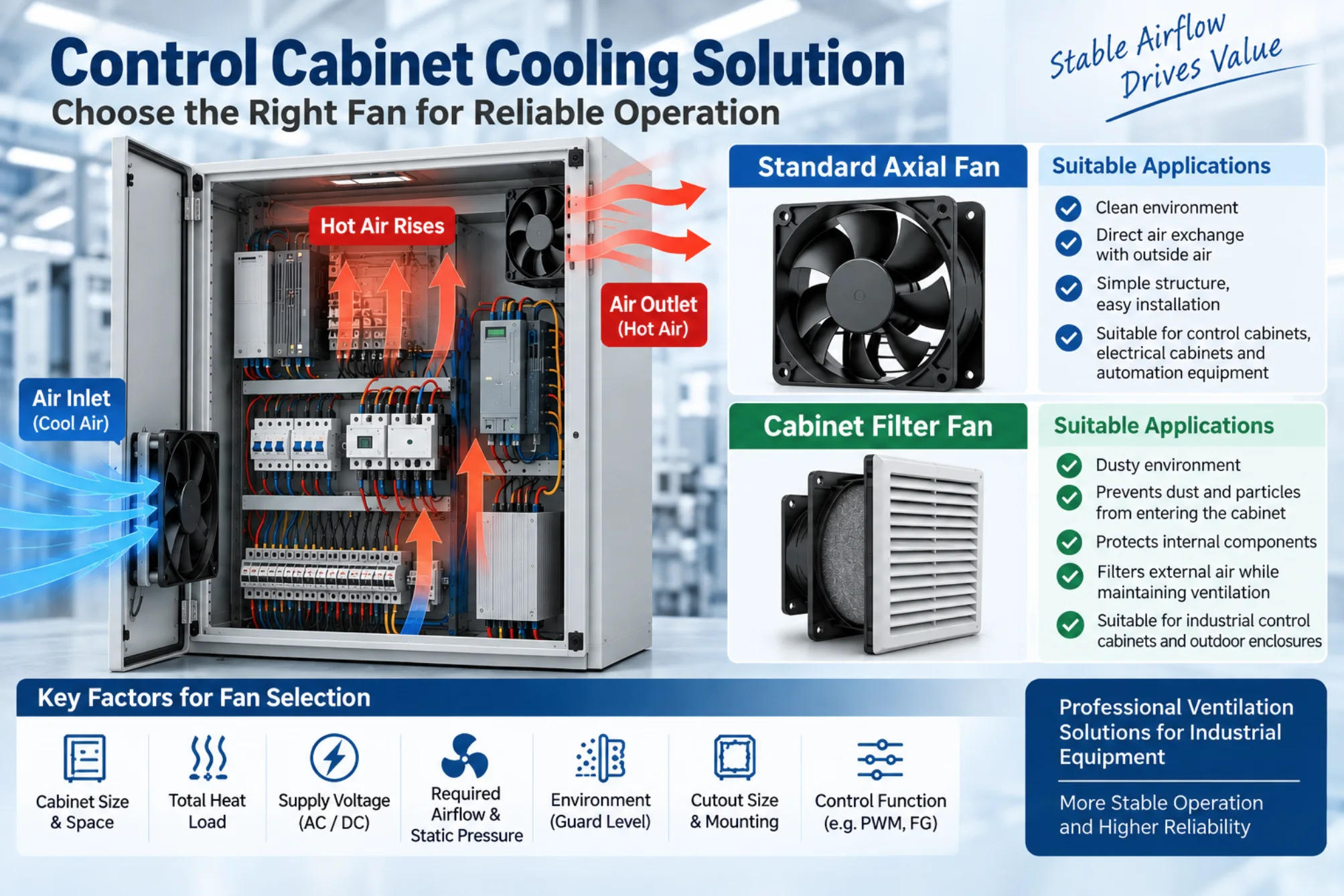
PLCs, variable frequency drives (VFDs), power supply modules, relays, and motor drives installed in control cabinets, electrical enclosures, and automation equipment continuously generate heat during operation. Excessive temperatures inside the enclosure can shorten the service life of electronic components and, in severe cases, may trigger protective shutdowns. Therefore, the first step in cabinet cooling is to determine the heat load, rather than selecting a fan size first.
When the ambient temperature is lower than the maximum allowable temperature inside the enclosure and the equipment allows air exchange with the surrounding environment, forced-air ventilation is usually a simple and practical cooling method. In relatively clean environments, axial fans can be used for direct ventilation. In dusty environments, cabinet filter fans are generally more suitable because they filter the incoming air before it enters the enclosure.
After determining the required airflow, system resistance must also be considered. Filter media, louvers, heat sinks, densely arranged components, and narrow airflow passages all create resistance. Once a fan is installed in the system, the actual airflow is typically lower than its maximum free-air airflow. Therefore, fan selection should not be based solely on a single airflow value listed in the product catalog.
The positions of the air inlet and exhaust also directly affect cooling performance. A common approach is to introduce cooler air from a lower position, allow it to pass across the main heat-generating components, and exhaust the warmer air from a higher position. The inlet and exhaust should not be positioned too close together, as this may cause airflow short-circuiting. For equipment with concentrated heat sources, the airflow path should also be designed according to the location of those heat-generating components.
Deqing Jiefeng Electric Co., Ltd., under the JIEFENGFAN brand, provides industrial axial fans and multiple series of cabinet filter fans for control cabinets, electrical enclosures, automation equipment, and other industrial cooling applications. For accurate product selection, it is recommended to provide information such as cabinet dimensions, total heat dissipation, ambient temperature, maximum allowable internal temperature, supply voltage, cutout dimensions, and required dust protection level.
A complete cabinet cooling and fan selection process can be summarized as:
Heat Load & Allowable Temperature Rise → Required Airflow → Filtration & System Resistance → Fan Operating Point → Installation Position → Protection & Maintenance
Following this process is generally more reliable than selecting a fan based solely on the cabinet cutout dimensions.
For further product selection, please prepare the mounting dimensions, operating voltage, required airflow/static pressure, operating environment, continuous operation requirements, and required control functions, and then compare these requirements with the specifications of the relevant products.